

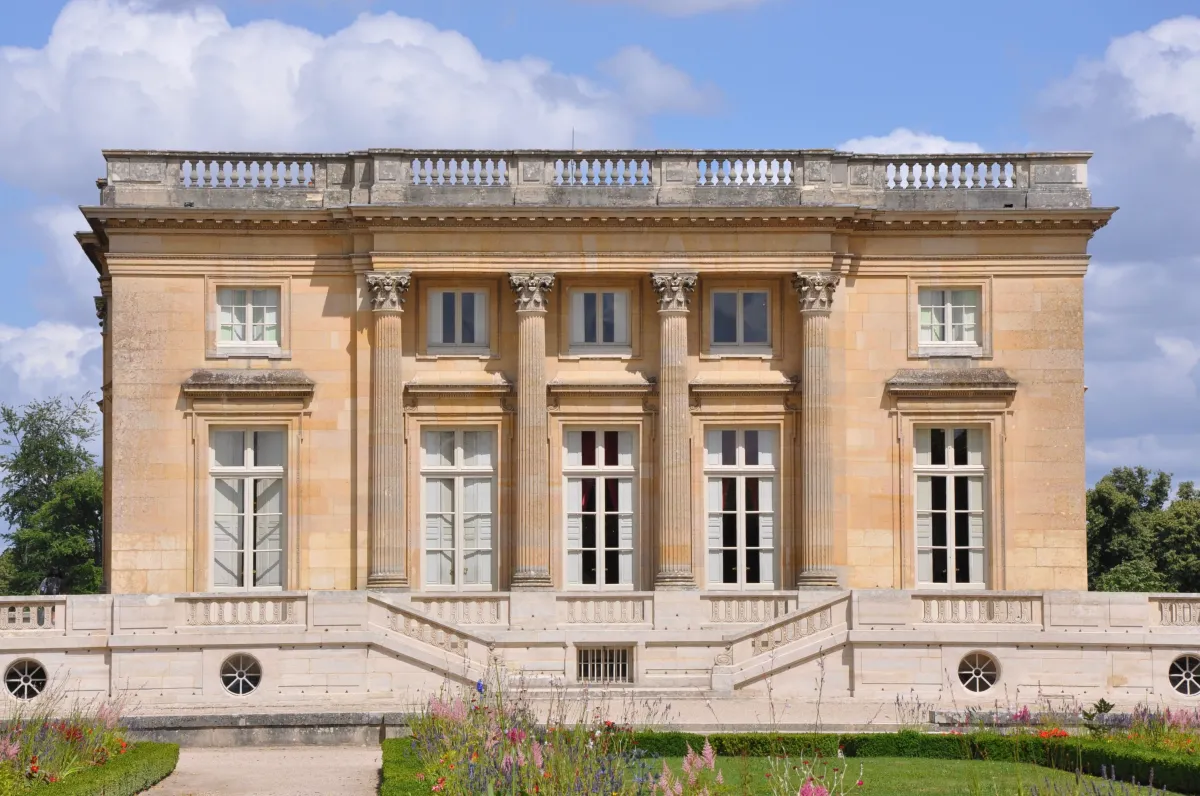
Petit Trianon
An Intimate Royal Retreat
Just a few minutes' walk from the Grand Trianon, the Petit Trianon is undoubtedly one of the most moving places in Versailles. Given to Marie Antoinette by Louis XVI in 1774, this small neoclassical palace quickly became her personal refuge, far from the constraints and heavy gazes of the court.
Elegance, Freedom, and Light
Visiting the Petit Trianon reveals another facet of royal life: more free, more feminine, more human.
The palace is distinguished by its sober architecture, its refined furniture, its harmonious volumes, and its light-filled rooms. Everything is designed for the comfort, intimacy, and independence of a queen who sought to simply become a woman again.
The English Garden and the Queen's Hamlet
Around the palace, the English garden, with its winding paths and natural perspectives, invites you to stroll.
Don't miss the Queen's Hamlet, this small rural village created from Marie Antoinette's dreams: romantic thatched cottages, a working farm, a vegetable garden, and a bucolic lake.
A timeless, gentle, and enchanting place, perfect for imagining the queen walking barefoot in the grass or feeding the animals.
Plan Your Visit in Advance
To optimize your time, it is strongly recommended to consult the Château de Versailles website before your visit. You will find the opening hours, admission fees, and any exceptional closures there. This will allow you to avoid unpleasant surprises and fully enjoy your visit.
Choose the Right Time
The Petit Trianon is a very popular place. For a more peaceful experience, favor visits during the week, early in the morning or late in the afternoon. Avoid weekends and public holidays, when the crowds are generally larger. You will enjoy the atmosphere of the place more.
Explore the Gardens
The Trianon estate is not limited to the Petit Trianon itself. Take the time to stroll through the English gardens and the Queen's Hamlet. These spaces offer a different perspective on life at court and are particularly pleasant on sunny days. Don't forget your comfortable shoes!
Use the Visit Supports
The Château de Versailles offers various visit supports to accompany you, such as audio guides or mobile applications. These tools can provide you with detailed information on the various rooms and works of art you will encounter. Do not hesitate to use them to deepen your knowledge.
Allow Time
Visiting the Petit Trianon and its gardens can take time. Allow at least 2 to 3 hours to explore the different spaces and fully enjoy the atmosphere of the place. Feel free to take breaks to rest and admire the scenery.
(in 10:35)
Commissioned by Louis XV
The Petit Trianon, which you can visit today, was commissioned by King Louis XV to his architect, Ange-Jacques Gabriel. Its construction began in 1762 and was completed in 1768. It was designed as a retreat away from the heavy etiquette of the court of Versailles. The king wanted an intimate space where he could devote himself to his passions, including botany and the company of his favorite, Madame de Pompadour. Unfortunately, Madame de Pompadour died before the work was completed.
Madame du Barry and the evolution of the estate
After the death of Madame de Pompadour, Louis XV continued to visit the Petit Trianon, using it as a place of entertainment and respite. He then offered it to his new favorite, Madame du Barry. The estate continued to evolve with the addition of an English garden, contributing to the bucolic and private atmosphere of the place. This English garden, more informal than traditional French gardens, reflected the tastes of the time for nature and simplicity.
Marie Antoinette and the Petit Trianon
The Petit Trianon entered a new chapter in its history when Louis XVI offered it to his wife, Marie Antoinette, in 1774. The queen became passionate about this place and had many improvements made, transforming the estate into a space that reflected her personal tastes. She particularly appreciated the intimacy and freedom that the Petit Trianon offered her, away from the gaze and constraints of the court.
The French Revolution and its impact
During the French Revolution, the Petit Trianon, like the rest of the Versailles estate, was affected by the events. The furniture was sold and the gardens were somewhat neglected. However, unlike other places of the monarchy, the Petit Trianon did not suffer major destruction. It was used for various purposes, including as an inn and workshop.
From the Empire to the present day
Under the Empire, Napoleon I had the Petit Trianon restored and offered it to his sister, Pauline Bonaparte. Over the ages, the Petit Trianon had different assignments before finally being restored and opened to the public. Today, you can visit it and admire the refinement of its architecture and its gardens, witnesses to the history of France and its royal figures. The restorations allow us to better understand the intimate atmosphere sought by Louis XV and Marie Antoinette.
The Gardens of the Petit Trianon
Explore the magnificent gardens of the Petit Trianon, designed to be an oasis of tranquility. Children will love strolling through these green spaces and discovering the different garden styles, from the French garden to the English garden.
The Temple of Love
Don't miss the Temple of Love, a charming building that evokes romance and beauty. Children will be captivated by its architecture and picturesque location. Ideal for photos!
The Queen's Hamlet Farm
Although located near the Petit Trianon, the Queen's Hamlet offers an immersion into 18th-century rural life. Children will enjoy discovering the farm animals and the picturesque buildings. It's an excellent opportunity to tell them about history and life in Marie Antoinette's time. Allow time for this visit.
The Belvedere
This pavilion offers a breathtaking view of the gardens. Children will love observing the landscape and imagining what Marie Antoinette could see from this privileged point of view. Its original architecture is an additional point of interest, an ideal place for a short break.